Rising from the cobblestones of Piazza Bra, the Verona Arena has drawn crowds since the age of Roman emperors — and it has never once stopped performing. Few monuments on earth can claim two millennia of unbroken use, making this elliptical giant one of history's most extraordinary survivors.
Construction of the Verona Arena began around 30 AD during the early Imperial period, making it a near-contemporary of Rome itself at its political zenith. Commissioned to serve the prosperous Roman colony of Verona — a strategic crossroads city in the Po Valley — the amphitheatre was built using pink and white limestone quarried from Valpolicella, the same region now celebrated for its wine. Designed to hold an estimated 30,000 spectators, it ranked among the largest amphitheatres in the entire Roman Empire, surpassed in scale only by the Colosseum in Rome and the Capua Amphitheatre. Its construction reflected both civic pride and imperial ambition.
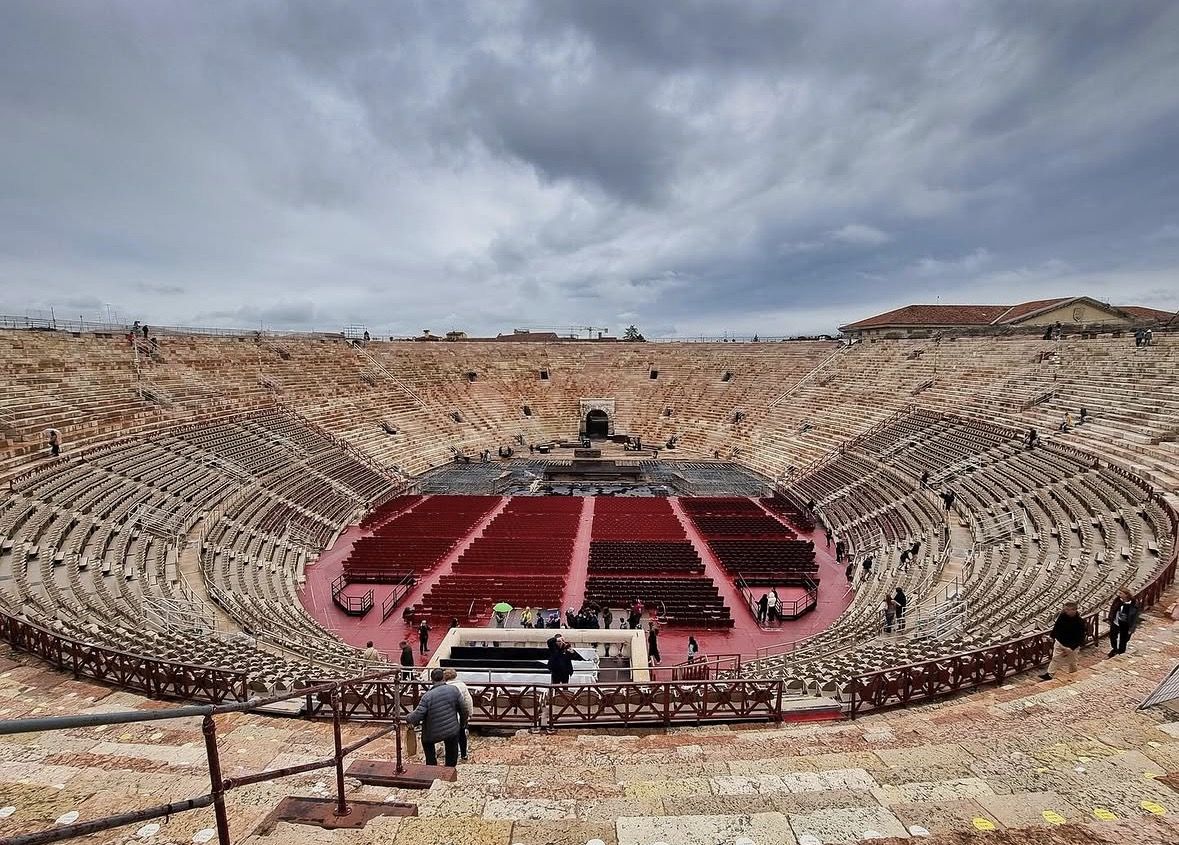
The Arena's elliptical footprint measures approximately 152 metres in length and 123 metres in width, with the cavea — the tiered seating area — rising to an original height of four exterior rings. Gladiatorial combat, wild animal hunts known as venationes, and public executions drew enormous crowds from across the surrounding region. The sophisticated engineering included a complex underground network of tunnels and chambers beneath the arena floor, used to house animals, gladiators, and mechanical stage equipment. Roman engineers also solved drainage challenges from the Adige River nearby, embedding the structure so firmly in the landscape that it has endured for twenty centuries with remarkable structural integrity.
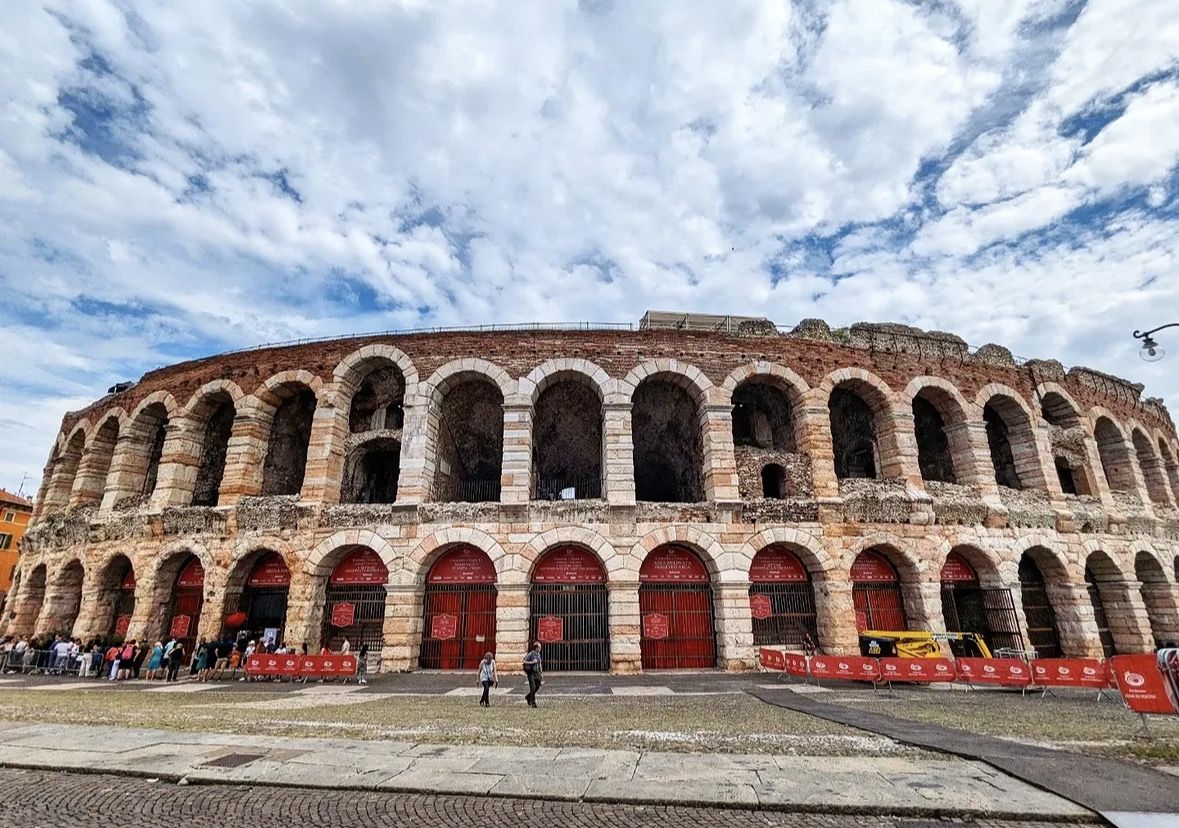
The Arena's most dramatic architectural feature today is the Ala, a surviving fragment of the original outer ring comprising four arched bays that jut skyward on the northwest side. This isolated wing is all that remains of the Arena's elaborate exterior facade after a catastrophic earthquake in 1117 AD brought down almost the entire outer enclosure. Far from being a mere ruin, the Ala serves as a poignant monument to what was lost — and a reminder of the engineering excellence that allowed the inner two rings and the vast seating bowl to survive largely intact. The contrast between the lone fragment and the complete inner structure remains one of Verona's most haunting visual experiences.
Following the collapse of Roman authority in the 5th century, the Arena did not fall into total abandonment as many comparable structures did. Medieval Veronese citizens adapted it pragmatically, using the interior as a residential quarter and marketplace. Entire families built homes within the arched vaults during the early medieval period, a practice that inadvertently helped preserve the structure by keeping it inhabited and maintained. By the 12th and 13th centuries, the Arena had resumed its role as a venue for public spectacle, hosting tournaments, jousting contests, and civic ceremonies. Successive rulers of Verona — including the powerful Scaligeri dynasty — recognised its symbolic value and helped protect it from further deterioration.
The Renaissance brought renewed scholarly and artistic interest in ancient Roman monuments across Italy, and the Arena benefited directly. Humanist scholars documented its dimensions, local authorities began clearing medieval encroachments from the interior, and early performances — initially religious mystery plays and later secular entertainments — returned crowds to the ancient tiers. By the 16th century, Verona's civic identity had become inseparably linked with the Arena. Elaborate festivities, including the famous annual Giostra del Saracino, were staged within its walls. This centuries-long continuity of public use distinguished Verona's amphitheatre from contemporaries like the Colosseum, which had slipped into quarried ruin and symbolic monument rather than functional venue.
The pivotal moment in the Arena's modern story came on the 10th of August 1913, when a spectacular open-air production of Giuseppe Verdi's Aida was staged to commemorate the centenary of the composer's birth. Verdi himself was a native of the nearby Emilia-Romagna region, making the tribute deeply resonant. The production, conceived by tenor Giovanni Zenatello and impresario Ottone Rovato, drew an audience of around 8,000 people and was received with thunderous acclaim. The marriage of Roman stone and Italian opera proved so powerful that it became an annual tradition, effectively creating one of the world's most iconic and enduring performance events: the Verona Opera Festival.
The Opera Festival, now known formally as the Festival Lirico dell'Arena di Verona, runs each summer from late June through early September and attracts audiences from across the globe. Productions are staged with breathtaking scale — massive painted sets, casts of hundreds, live animals, and elaborate lighting designs transform the ancient space into something between theatre and dreamscape. Operas such as Aida, Carmen, Nabucco, Turandot, and Romeo and Juliet cycle through the programme, performed against the backdrop of 2,000-year-old stone tiers lit by thousands of audience members holding traditional candles at the opening of each evening. The candlelight tradition, organic and spontaneous in origin, has become one of the festival's most beloved rituals.
Beyond opera, the 20th century saw the Arena expand its cultural programming significantly. Rock and pop concerts brought the venue to new global audiences, with legendary performances by artists including Frank Sinatra, Elton John, Pink Floyd, and Sting adding a contemporary chapter to the Arena's long story. The 1971 live album recorded by the band Yes at the Arena — simply titled Yessongs — introduced the monument to rock audiences worldwide. These events demonstrated the Arena's unique adaptability across genres and eras, reinforcing its status not merely as a museum piece but as a living, breathing stage capable of hosting any form of human spectacle its architects could never have imagined.
Today the Arena di Verona welcomes approximately half a million visitors every year, combining daily access as a museum and archaeological site with its celebrated summer opera season. During the day, visitors explore the cavea freely, climbing the ancient stone tiers to panoramic views across Verona's terracotta rooftops and the distant Alps. The underground galleries, once inhabited by gladiators and wild beasts, are partially accessible and offer a visceral connection to the structure's Roman origins. Multilingual guided tours, audio guides, and interactive exhibitions help contextualise two thousand years of history, while the adjacent Piazza Bra provides a lively backdrop of cafes, restaurants, and street performers.
Whether you attend an evening performance of Aida under a canopy of Italian stars, watch the setting sun turn the limestone tiers to gold during an afternoon visit, or simply stand in the centre of the arena floor imagining the roar of 30,000 Roman spectators, the experience is genuinely unforgettable. The Verona Arena is not a relic preserved behind glass — it is a monument that insists on being used, enjoyed, and celebrated. Few places on earth compress so much history, beauty, and living culture into a single ellipse of ancient stone. Come prepared to be moved, and come prepared to return.
Ready to Experience It Yourself?
Skip the queues and make the most of your visit with a guided tour that brings two thousand years of gladiators, opera, and Roman engineering vividly to life. Whether you are planning a daytime exploration or a magical opera evening under the stars, booking in advance guarantees your place inside one of the world's greatest ancient monuments. Secure your tickets today and let the Arena di Verona write its next unforgettable chapter with you in the audience.
Book Your Tour Now